Sunday, November 30, 2008

World AIDS Day 2008


World AIDS Day is observed every year on December 1st. The World Health Organization established World AIDS Day in 1988. World AIDS Day provides governments, national AIDS programs, faith organizations, community organizations, and individuals with an opportunity to raise awareness and focus attention on the global AIDS epidemic.

Take Action

There are many ways you can take action in response to HIV/AIDS:

-get tested for HIV
-practice safe methods to prevent HIV
-decide not to engage in high risk behaviors
-talk about HIV prevention with family, friends, and colleagues
-provide support to people living with HIV/AIDS
-get involved with or host an event for World AIDS Day in your community

**For more information on Worlds AIDS Day or to learn more about prevention, risks and awareness campaigns, go to http://www.hhs.gov/aidsawarenessdays/index.html

Saturday, November 29, 2008

First National GD Fair Trade Party!

We are very pleased to announce that Global Daughter has gone National! We had our first Fair Trade Party in Fort Wayne, Indiana courtesy of Joan and Adam. They reported an amazing turnout and response to the product and the story behind it. We are looking forward to expanding our parties throughout the US, and thanks to Joan and Adam it seems like this could be a very successful endevour for women right here at home.
If you are interested in becoming a Global Daughter Consultant please contact Erika at erika@globaldaughter.com

Thanks again to Joan, Adam, Amanda, and Fort Wayne for your support!


The Display


Global Son??


The Hostess Joan put out quite a spread!


Filling out their orders.


Trouble deciding? Take them all!

Tuesday, November 25, 2008

Erin's Scooty Mishap


Another pain med?? Sure.

That is shock, not happiness.

Recently Erin took quite a nasty tumble on her scooter ride in Pokhara. Luckily her brother, Tony, was there to help her out. Erin still had to make the hour drive, in shock, to the nearest medical facility to get stitches.
Back in Kathmandu Erin tried to see her doctor to tend to the wound. Unfortunately, there was a riot that day and a burning bus in front of the hospital so she could not make the appointment. Two days later she went in and they discovered that her wound had become infected in the bone and that she would require surgery. She had it done immediately with several friends there to help her through it. We are hopeful that even though Nepal is not renowned for their medical services that the recovery will go smoothly.
This Thanksgiving, Erin will be laid up in her bed recovering, so please keep her in your thoughts.

Wednesday, November 19, 2008

Trafficking is Real.

Women and Girl's Trafficking in Nepal is a prevalent practice throughout the country. Girls are literally plucked from small villages as their parents are promised that they will have a prosperous future "working abroad." Some parents believe that their daughters will find domestic work in India, but some know they will enter the sex trade in major Indian cities. The girls, too, are scammed by "traders" into thinking they will find employment and wealth in the big city. Most are uneducated and desperate and they are taken advantage of by people who have no conscious or humanity.

It is a sad reality for poor families in disadvantaged corners of Nepal. Girls are often seen as a burden for parents- some would rather have them "disappear" than feed and take care of them. So they send them to their fate in back alleys and brothels in India. Here they are abused, raped and treated like animals. They are alone, scared and literally trapped.

Many anti-trafficking organizations based in Kathmandu are working to recover missing girls and rehab those that have been exposed to the sex trade in the past. They perform undercover-type activities to catch sex traders and infiltrate trafficking networks. In some operations, the organizations set out to stop tourist buses and micro vans that come from Nepal and cross the border into India.

One of the producers we work with in a border city to the West relayed to me this story a few days ago. He was on a bus from Kathmandu to the border and about 5KM before the border check area, the bus was stopped by a group of women literally in the middle of the road. They boarded the bus and showed papers that proved they were with Maiti Nepal, one of the most well-known anti-trafficking organizations. They demanded to see ID papers from all those on the bus. They said they were checking for girls who were being trafficked into India. As they checked everyone, they discovered that a man was on board with two young girls, who were neither his daughters nor family members. The girls were questioned outside the bus and it came out that they had been taken from their village a few days earlier by this man who promised to find them work in Calcutta. The man was taken into custody and the girls were escorted back to Maiti Nepal headquarters in Kathmandu for observation and counseling.

When I was hearing this story it gave me chills. This NGO has taken the initiative to attack a problem that the government has been unable to address. And in doing so, they have highlighted the immense need for continued efforts by the government to end this appalling human rights violation. The laws against traffickers are too lenient and the money that changes hands in the web of the sex trade industry in Nepal is the dirtiest money around. People are paid off, families are lied to by both authorities and traffickers, and at the end of the day, girls are still vanishing.

Initiatives taken by Maiti and other NGOs are hopeful. The rehabilitation programme at Mathi is famous. Women staying in the Center even produce handicrafts as a way to earn a living wage. Global Daughter is in touch with the Center and will more than likely be selling a few of their products on-line soon. Supporting this group means saying "no" to sexual exploitation and saying "yes" to empowerment. It is not enough to rehabilitate their spirit, we must offer them a new way of life. By becoming a working artisan, they are given the opportunity to retain stable employment and appropriately integrate back into society. The Center encourages women to be financially secure by teaching them a variety of income generating skills.

We look forward to being associated with this group and joining the fight against domestic violence, trafficking for flesh trade, child prostitution, child labor and forms of exploitation and torture.

For more information about Maiti Nepal, please visit their website at: http://www.maitinepal.org/pages.php?option=About%20Us

Sunday, November 16, 2008

Sewing Machine Project Update


In the past two months Global Daughter has been able to raise the funds to purchase two sewing machines for our women producers at the Janakpur Arts and Crafts Center. In a shopping trip with our lead designer, Lanjana, and co-owner of the Center, Ajit, we decided on an electric sewing machine and a foot peddle "fashion maker." Lanjana was very excited to have a new and modern machine- especially the fashion maker which will allow for better finishing work and detail.

Both machines were presented in Janakpur to the workshop's manager, Rina. Due to major flooding in the area, GD could not attend the ceremony to bless the sewing machines. We did, however, receive a letter from Rina thanking us and our contributors for the new additions. She said they look forward to beginning work with the machines as soon as possible.

We would like to thank everyone who contributed to the project by either purchasing a GD signature shopping bag or donating funds. We were overwhelmed by the out pour of support for the cause and will be extending the project so that we can purchase more supplies for the center in the future.

The success of this project inspires us to find new ways to assist women artisans and provide them with the tools to be successful. Stay tuned to learn what new GD project you can be a part of!
On behalf of Global Daughter and the woman at JAC, thank you for making a difference....one stitch at a time.
*A very special thanks to Kerry Clark of Federal Way and to the Auburn Soroptomist Group for their extremely generous donations.
Purchase your "I am a Global Daughter" shopping bag today to join the Sewing Machine Project...

Wednesday, November 12, 2008

Find a GD Holiday Event Near You!


This season don't just give a gift....tell a story.

Please visit us at one of the events listed below this holiday season to pick up your handmade-fair trade gifts. With prices starting as low as $5 you don't have to worry about going over your limit and you can still make a purchase that matters!

Thursday, November 20th
Holiday Magic Chat Party, Seattle
The Fairview Club
2022 Boren Ave. Seattle 98121
6PM-9PM
Tickets: $44.00 per person. Includes appetizers, wine and shopping. No-host bar provided. Please visit
http://www.chatwithwomen.com/ for your ticket or more information.

Saturday, November 22nd
Rock Creek Shopping Parade, Maple Valley
Rock Creek Housing Community
Start Time: 10AM (All Day Event)
*This is an event put on by Rock Creek Community. There will be open houses with a wide range of gift items for sale. Please email
erika@globaldaughter.com for Global Daughter's specific address at this event.

Saturday, November 29th
Holiday Open House, Kirkland
10AM-8PM
*Please join us for food, shopping, special holiday discounts, and fun for an all day open house. Please email
erika@globaldaughter.com for more details.

Saturday, December 6th
Tyee Holiday Bazaar, Sea Tac
4424 S. 188th St Sea Tac, 98188
9AM-4PM
*Sponsored by DECA, this is a great opportunity to pick up some unique gifts from local crafters and of course Global Daughter!


In addition to these events, Global Daughter is continuing to throw Fair Trade House Parties. If you are interested in hosting a party, please contact Erika. The hostess will receive a free gift in addition to 50% of any item.

Our online boutique, www.globaldaughter.com is also a great place to do your holiday shopping. Between now and the holidays spend $150 or more and receive free shipping!

We hope to see you at one of our events! Thanks to everyone for their continued support of Global Daughter.

Thursday, November 6, 2008

Nepal-India Treaty Needed to Curb Trafficking

This from Nepal Kantipur Report:

KATHMANDU, Nov 5 - It is not possible to provide justice to survivors of trafficking and to punish traffickers unless there is a bilateral treaty between Nepal and India, a regional conference concluded.

"Countries in South Asia should have a common legal standard to trace and punish traffickers," said Sabin Shrestha, an advocate associated with Forum for Women, Law and Development (FWLD). "For Nepal, special bilateral treaty with India is a must to combat human trafficking."
He said this at the Regional Meeting for Media, Lawyers and Professionals organised by United Nations Development Fund for Women (UNIFEM).

According to Shrestha, Nepal is the country of origin and India is the major destination of human trafficking. The current agreements between the two countries do not include human trafficking. As a result, it is very difficult to produce adequate proof to punish traffickers.

"Only brokers are getting punishment not those who buy our Nepali people," Shrestha said. "If there is proper extradition treaty or common standard legal provision, it would be easy to punish both brokers and buyers involved in human trade."

According to him, till date, evidences documented in India are not accepted as proof in Nepal. For example if an NGO rescues a Nepali woman from an Indian brothel, Nepali authorities do not take this as proof.

There should be a record of those leaving for India and coming from India, which would make it easier to trace traffickers, he said.

Due to lack of sufficient proof, legal protection and support mechanism as well as social stigma and threats from traffickers, survivors of trafficking do not register their case with the police. He also said that the very few incidences of conviction have deterred survivors.

According to one study carried out by FWLD, only in about 33 percent of the registered cases is there a conviction.

International Labor Organization estimates that about 12,000 women and children are trafficked from Nepal every year. However, police records show that during 2006/07 only 112 cases of trafficking were filed with the police, while the number during 2005/06 was 97 and it was 72 in the year 2004/05.

Aruna Thapa of UNIFEM said that SAARC Convention on Preventing and Combating Trafficking in Women and Children for Prostitution, 2002, also has provisioned for bilateral treaty. "But this has not been followed up, due to which traffickers go scot-free as Nepali authorities cannot take action against Indian criminals involved in human trafficking and Indian authorities cannot punish Nepali traffickers," said Thapa.

Tuesday, October 28, 2008

The Word is Spreading....

Global Daughter was featured in this week's Business Examiner. We invite you to read the article below:


Global Daughter aims for worldwide focus on foreign exports
10/27/2008
Source: Business Examiner
Author: Breanne Coats

There are numerous Web sites that sell unique products to customers online. There are also numerous female advocacy sites on the Web as well. What two Auburn natives felt was missing, though, was a combination of these two types of sites.

Global Daughter works with Nepali women designers, painters, tailors, master cutters and jewelers on a regular basis to create products that the business can then sell to Western consumers.

Owners Erika Mosebach and Erin Miller started Global Daughter to empower working women in Nepal. They are in charge of the Web site, www.globaldaughter.com, but all of the products that are sold through the Internet site are produced by women in the Himalayan mountains.
“We started from scratch and are trying to fine tune,” Mosebach said. “We want to give them all the tools to succeed.”

The company uses the phrase, “for women, by women, inspired by all women,” to promote its products.

The site features the following types of merchandise: jewelry, handbags, natural paper, home decor, organic tea and children’s products. From business cards, product tags and screening on merchandise, Mosebach said, women in Nepal not only make the products they sell, but also the various things they use to promote Global Daughter.

When shopping at places with “fair trade” products, Mosebach said, sometimes customers can't be sure if the businesses really are abiding by fair trade practices.

But with Global Daughter, people can rest assured, she said, since either she or her partner will actually be in Nepal helping the women get materials and paying them for their products directly.

In the future, Mosebach and Miller plan to expand Global Daughter to other countries. Their next stop will probably be Cambodia, Mosebach said.

Global Daughter started with Nepal because the two founders had a personal connection there and wanted to do something to help. It is one of the poorest countries in the world and the level of corruption there makes it even harder for money to trickle down to the regular citizens.
Global Daughter aims to get money directly into residents’ hands, specifically women, since they are often viewed as second-class citizens.
While the online boutique’s merchandise is made from products found in Nepal, Global Daughter does not try to make its products “scream Nepal.” Rather, Mosebach said, they are aiming to make their products more marketable in the United States.

The business has especially formed a close relationship with the artisans and management of Janakpur Arts and Crafts Center. This center provides clean working conditions, fair and reasonable working hours and wages. It also provides in-workshop meals to its women workers, according to Global Daughter.

To help get their business rolling, Mosebach has been hosting Global Daughter parties. She goes to people’s homes and shares the stories of its operations and the women it works with from Nepal. People can pay for and receive Global Daughter’s products at these parties.
“We’ve just had a great response,” Mosebach said. “Women love to get together and shop for a cause.”

While the two entrepreneurs do hope they can make some sort of living from the site, Mosebach said it is really more about making change in the lives of Nepali women.

Mosebach and Miller have to deal with a lot of unforeseen problems.

For example, the people in Nepal frequently go on strike. And when they do, no one works, which can stall the online retailer’s business.

Also, if one of the women who makes a particular product gets sick, Global Daughter may just have to go without that product until the woman-producer gets better.

Yet, these issues do not deter Mosebach and Miller from following through with their goals.
“The mission is to hopefully empower women worldwide to lift themselves out of poverty,” Mosebach said.

Monday, October 20, 2008

Skills Training w/ Lanjana


In September Global Daughter sponsored our lead designer, Lanjana, in a skills training workshop in Kathmandu. Here she was instructed by a fashion desinger from India on techniques in fushion of raw materials. For example, combining leather with elephant grass or nettle fibers with wood or bamboo. She attended the one-week course with about 20 other women artisans from the valley. We were proud to have her there representing our producers, Janakpur Arts and Crafts Center. She told me she learned many new things, and already she has started to produce protypes. We are very fotunate to have her associated with our project and hope to get her involved in more skills development workshops in the future! (Also, congratulations to Lanjana on her up-coming marriage!)

Friday, October 17, 2008

Breathe.

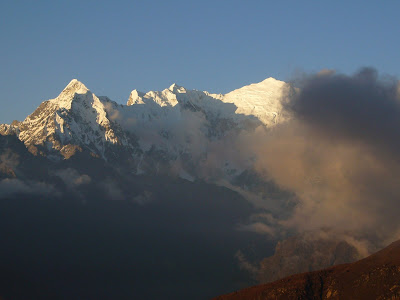
I just returned from the most beautiful trek in the Langtang Himalayan Region. I decided to pick up the walking sticks and head away from the city and rejuvenate. On the seven-day excursion I was able to see four of the highest peaks in Nepal and well into the Tibetan Himalayan Region. The panoramic views from near the famous Goisakund Lakes, was stunning. You could see the peaks, Ginesh Himal, Langtang, Annapurna, Machupuchare and a slew of other smaller peaks. This area is mostly made up of Tibetan communities or Nepali Tamang ethnicities. The language is different from Nepali as well as the food and the customs. It was at times a very difficult trek, but worth every sweaty step. The great thing about trekking is that it really is just...walking. That is the secret. You just walk around and then stop to eat and walk again, look at stuff. Of course, when you get up to 4500 meters (14,800 ft) then it becomes very slooooow walking!

I met heaps of fantastic people along the trail and made friends with a few of the children at home in the villages on holiday. In one of the tea houses I stayed at, the woman who looked after the place knitted me some arm warmers. I want to sell them at Global Daughter, but the logistics of getting them back to KTM from 4,000 meters would be a nightmare. They are very cute, though and I look forward to wearing them this winter.

Life in the mountain regions is quite different than anywhere else in the country. Kids are used to walking up and down mountains, literally, to attend school or retrieve cooking gas, eggs, blankets... everything really. They will blaze past any fit trekker on the trail and they can handle the high altitudes like champs. They were born into it. On the trail I saw young women porters who weighed about 50Kgs (110lbs), carrying 40-50Kgs of baggage and equipment on their backs. Heaving up steep steps and dangerous foot paths. I was in awe. Some porters don't wear shoes and most don't have what we would consider "proper" trekking gear.

It was nice to get out into nature again after six months stuck in the polluted and noisy KTM valley. Out there it seems like time has stopped and it doesn't take you long to adjust to the pace. I sometimes forget that I live amongst the highest and most breathtaking mountains in the world. The trek made me realize even more how lucky I am to be here, in this place, doing what I love to do. The Nepalis I met in the mountain villages are so far removed from the politics and greed of the city, it reminds you that they are the most welcoming and peaceful people in the world. The simplicity of life is inspiring and the intense sense of family relationships is beautiful.

It is true.

When you sloooooow things down, you can see what you are supposed to... a whole lot clearer.


Langtang Peak. Dusk.

Breathe.


Flying kites is the coolest.


up, up, up...


Ginesh Himal, Annapurna Peaks from Laurabina.


Tamang village- Thulo Saphryu

This chunk was just sitting by herself, all alone in the middle of nowhere...mom was collecting fodder


Sunset


Knitting arm warmers by the fire.


4,500 meters- thin air and light head!

Monday, October 6, 2008

Fair Trade ll Fair Aid

Global Daughter is committed to Fair Trade standards. What is Fair Trade?

*Providing fair wages in the local context,
*Supporting safe, healthy, and participatory workplaces,
*Supplying financial and technical support to build capacity,
*Promoting environmental sustainability,
*Respecting cultural identity,
*Offering public accountability and transparency,
*Building direct and long-term relationships, and
*Educating consumers.


For more information please visit www.globaldaughter.com

Thursday, September 25, 2008

Ink

We are pleased to announce our second bit of Global Daughter Press! This interview was taken in our hometown of Auburn, Washington and appeared in the Saturday edition of the Auburn Reporter. We look forward to more exposure in the future and appreciate all the support!

Auburn tandem extends helping hand to struggling women half a world away

By ROBERT WHALE
Auburn Reporter News reporter
Sep 20 2008

With refueling stops in New York and Abu Dhabi, 35 bone-numbing hours separate SeaTac Airport from its counterpart in Kathmandu, Nepal.

But more than physical space separates those compass points. Nepal, one of the poorest countries on Earth, recently has passed through the bloody trial of 12 years of civil war that wrenched it from a monarchy to a democracy.

Kathmandu, its capitol city, reeks with garbage, its air is choked by automobile exhaust fumes, its sacred river is fouled beyond description. Water-borne diseases kill thousands of people every year.

Auburn natives Erika Mosebach and Erin Miller, who live in Nepal, say that it also is one of the few countries in the world where women, working 16-hour days with little or no pay and subject to all kinds of degradation, die before the men.

Mosebach and Miller, best friends from childhood and at 27 seasoned world travelers, are doing something to ease the lot of their sisters across the globe.

Their brainchild is Global Daughter, an on-line fair trade, global boutique aimed at improving the economic standing of vulnerable women in Nepal. Its goal is to help the women there earn a better living by selling their handiwork all over the world, not just in their local marketplaces.

Global Daughter dates to the spring of 2007 when Miller volunteered in Nepal. She would later show Mosebach some beautiful handicrafts from her adventure.

“Later, we both did a volunteer project there, and the idea kind of spun after that,” said Mosebach. “What we saw was that all these poor countries are getting money from different donors, but it’s never trickling down to the people who actually need it because so often the governments are corrupt.”

In January 2008, Mosebach who with Miller had spent three years traveling through Asia, moved to Nepal and Global Daughter was born. Through fair-trade initiatives and skills development training, Global Daughter creates an opportunity for otherwise marginalized women to find an outlet for their talent and connect to the global market.

And because they actually live in Nepal, Mosebach and Miller are able to connect with women in profound ways.

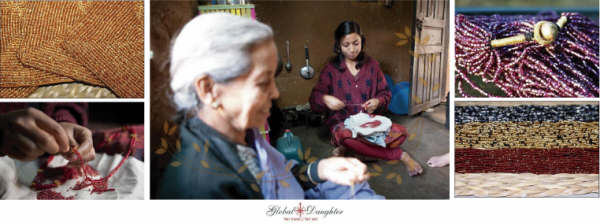
That’s how they met Urmilla, a 70-year-old widow, and her 24-year-old daughter, Roma, who takes care of her. Mosebach and Miller first ran into them on a visit to one of the local markets, where they sell their beaded jewelry.

“They haven’t worked with any foreigners before and don’t speak any English,” Mosebach said. “We get a local guy from the market to help translate the stuff. Their house is just a room that they pay $14 a month in rent for. There’s a bed in there, and they sit on the floor and bead all day and bring their stuff to the market. We have started having them make these Cleopatra malla necklaces, which are our biggest seller. They might sell a piece or two at the market, but now since we have started working with them, we have increased their orders. Now they can make twice the average daily income.

“… They are ecstatic,” Mosebach said. “They have never worked with a foreigner before, and here they have gone from selling maybe a piece or two a day to having these big orders. It is going to change their lives dramatically.”

For one thing, the spike in income will enable the women to send their daughters, not just their sons, to school.

Such success and business acumen might come as a surprise to some considering neither is a business major – Mosebach holds a B.A. in European studies and Miller has a B.A. in philosophy.

Mosebach and Miller have financed everything themselves. They saved money living in Japan where they taught English to kids.

“What we are trying to do is provide women with skills development training and give them the resources and tools they need to be financially independent and successful,” Mosebach said. “We take the skills that they already know, working with textiles, handmade paper and jewelry, and we modify their designs or give them new ideas so that we can bring their handicrafts to the Western market.”

Nepal, Mosebach said, is such a landlocked country that it is hard to get in and out of, and it is hard to import and export goods. For this reason, the economic boom that swept over India and China bypassed Nepal.

“... They have never been a democracy before, so the people don’t really know how to deal with that or what that means. So basically, the country is in disarray, and there is no real government there; they are just trying to figure everything out. And because of that, there are still a lot of problems,” Mosebach said.

Mosebach has been in Auburn since July but will return to Nepal in January. Miller is still in Nepal.

“I am back here handling all the logistics and marketing of the business, including the launch of the Web site. It’s been a tedious process,” Mosebach said. “We used the resources we had in Nepal to get our website done, but it’s hard to do that when you lose power for eight hours a day.”

Mosebach said she and Miller expect the Nepal operation to run itself in a few years. At that point they will move on, likely to Cambodia, and repeat their success there.

“Our ultimate dream is for women worldwide to know what their value is, what their worth is. We want to improve living conditions for women all over the world and provide economic independence for these people, help lift them out of situations of poverty and abuse,” Mosebach said.

“... Not every woman is a mother, not every woman is a wife, but every woman is a daughter, so we can all identify with that,” Mosebach added.

To read more and to view their products, visit www.globaldaughter.com.

Auburn Reporter News reporter Robert Whale can be reached at rwhale@reporternewspapers.com or 253-833-0218, ext. 5052.
Monday, September 22, 2008

Kathmandu Marathon/ 5K Kiddie Run


So I didn't actually do the marathon, or even run with the grown-ups, but I did have a great time in the kid's 5K division! My friend was running with kids from her orphanage, so I hopped in and had a go. My practice regime consisted of late nights, San Miguel beer, loads of tandoori and long walks behind the tail pipes of city buses. I was in no condition, but as a former runner, I thought I would dust off the old Nike Air Max 95s!


In total Nepali fashion it was disorganized, late and included a little spice of vandalism. The race was so poorly managed that organizers could not determine the winners of a few of the events. Some runners in the half marathon, full marathon, and 5K did not even reach check points and some rode on motorcycles to complete the race. There were only a few water stations along the route for the marathon runners, leaving them waterless for long stretches. Runners furious at the mismanagement of the event, resorted to vandalism at the national stadium- where all the races finished- shattering podiums and chairs. You know you are in Nepal when....

They did not block the roads so during one stretch of the race about 1,000 people were smashed onto the tiny sidewalk while buses, trucks and vans whizzed by, nearly clipping the heels of runners. I almost got ran over by one of the "volunteers" on his motorcyle. I also saw people cutting through the course along the way. There was no one directing runners, so it was a free-for-all. I was shouting to the kids, "Don't take the short cut in life!" and as I was getting passed by 5-year olds in pig tails and torn-up Ked sneakers, I realized that this marathon was a metaphor for Nepal and its future. Without going into it, I am sure you get it.

Anyways, it was a nice event, full of hilarity and that special touch of Nepali lawlessness. I can't imagine anything else I would like to be doing more at 5am on a Saturday morning.

Sunday, September 21, 2008

This is GOOD news...

I know most posts on this blog seem to show the negative aspects of Nepal's development. Good news and stories of progress do exist. This bit of news is fantastic and all Nepali's should find hope in between the lines. It is one area that the medical community in Nepal can be proud of....

Maternal Mortality Drops

Nepal's maternal mortality ratio has decreased significantly in the past eight years due to reduction in fertility rate, iron supplementation, increase in skilled birth attendance, and substantial increase in the coverage of antenatal care, UNICEF said Friday .

While the maternal mortality ratio was 539 per 100,000 live births in 1998, it came down to 281 per 100,000 in 2006, according to latest studies, the UN body said.

"Nepal is in line with meeting the Millennium Development Goals of reducing maternal mortality ratio," John Brittain of UNICEF said.

Nepal intends to reduce this by three-fourths of the 1990 level. Nepal's rate is better than that of India, Pakistan and Bangladesh in South Asia. Sri Lanka is the best country in the region in terms of maternal mortality ratio where the figure stands at 43 and Afghanistan is the worst with 1600 per 100,000 live births.


The maternal mortality ratio is the number of women who die at childbirth per 100,000 live births. In Nepal, 19 percent of births were attended by skilled birth attendants and 18 percent delivered their babies at health facilities in 2006 compared to 11 and 9 percent respectively in 2001, UNICEF says.

Key challenges that remain in this area include unmet needs for family planning and birth spacing to avoid unwanted pregnancies, and also lack of emergency obstetric care services, modern equipment and well trained personnel, said Ms. Gillian Mellsop, the UNICEF country representative in Nepal in a statement.

UNICEF supports the government in its policies in the health sector and has called for maternity services to be made free for all women in Nepal to help encourage attendance at good quality, well staffed health facilities nationwide, said the statement.

UNICEF Friday released a report Progress for Children: A Report Card on Maternal Mortality according to which more than 99 percent of all maternal deaths occur in developing countries, with some 84 percent concentrated in sub-Saharan Africa and South Asia.

source: www.kantipuronline.com